
Preteen/Teens Curriculum
-
About the Preteen/Teen Program
The Teen curriculum at Quantum is based on Tae Kwon Do, and begins to introduce forms from the adult Quantum curriculum, as well as techniques and exercises from Wing Chun and Jui-jitsu. In many TKD and Jui-jitsu schools, tournaments and competitions are the main focus for the students to measure their progress and achievement. This is not the case at Quantum: we provide a place for young people to learn about discipline while having fun, releasing energy, and developing social skills.
-
Belt Promotions
Every six weeks, we hold a belt test to determine who is ready to move forward to the next belt rank. Students will be tested on the curriculum for their current belt, and depending how they do, will be promoted to the next rank. Testings will take place during the regularly scheduled kids or teens classes. All students must be in full white uniform with their rank belt in order to participate in a belt test. They also need to be in a full white uniform to receive their promotion at the Belt Ceremony, which occurs one week after the test in their regularly scheduled class.
-
Belt Levels
In the Teen program, the rank belt has a black stripe down the center. There are two ranks in white belt and four ranks in each of the other color belts. The higher rank is signified by a stripe of the color of the belt that follows. For example a High White Belt would be identified by a pair of yellow stripes on the belt.
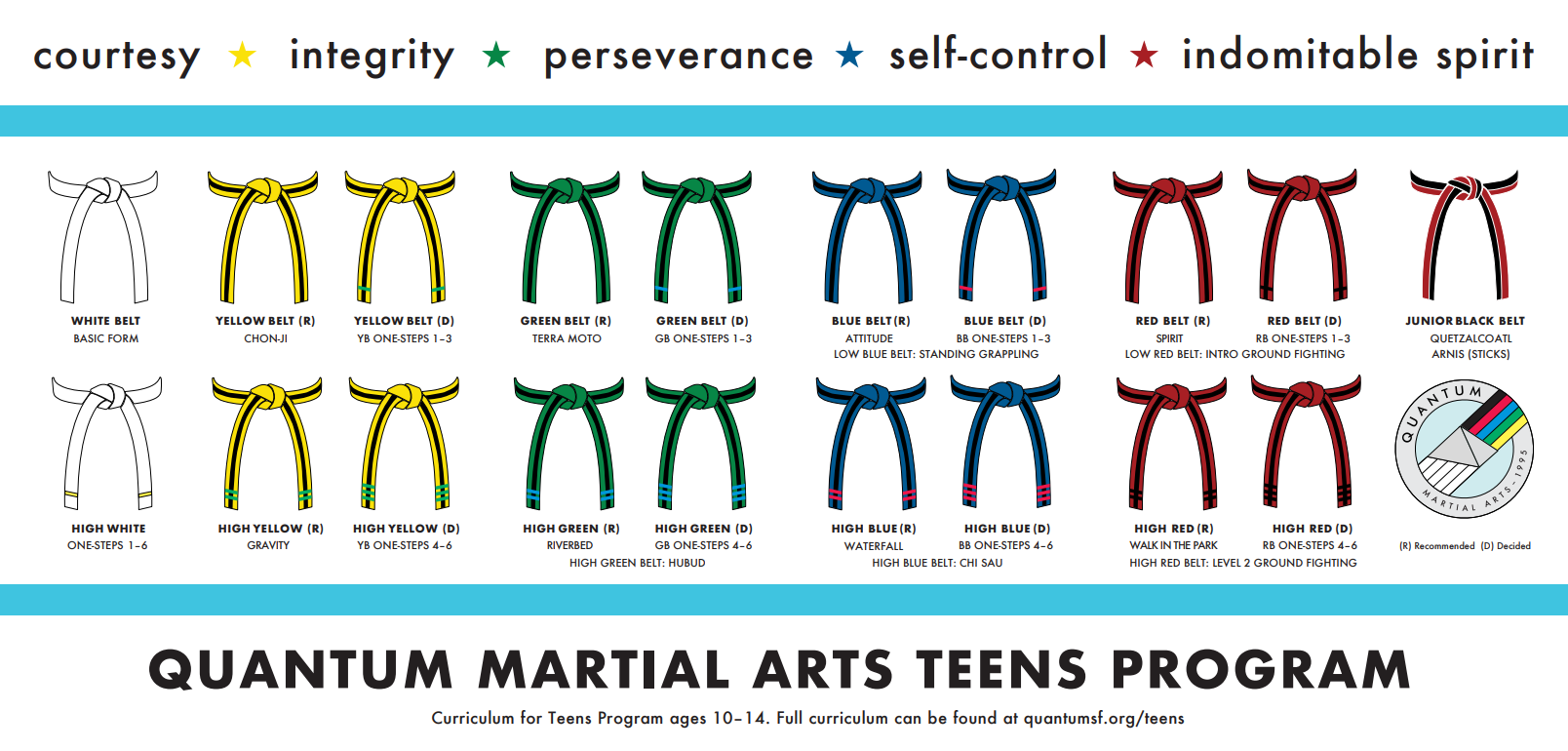
What Do I Need For My Next Test?
Remember, your curriculum is cumulative. When you move on to the next rank, you’ll still be required to demonstrate everything that came before it.
-
White belt at Quantum represents a blank slate. The color white symbolizes snow, emptiness, beginner’s mind. At Quantum, all a White Belt is asked to do is to come to class with an open mind and a willingness to learn.
There are two ranks for white belt, and you can tell who has earned a high white because they have a yellow stripe on their belt.
White Belt CurriculumHigh White Belt Curriculum
-
The color yellow is like seeds, planting something in the earth and intending for it to grow. Being a Yellow Belt is about showing patience, developing one step at a time.
Seeds don’t try to sprout during the winter, they wait until springtime when the conditions are right. There are five “elements” in Martial Arts, and the first one you learn about is “Earth”.
A martial artist is like a plant in the Earth. First a plant develops its roots, then it will begin to sprout and grow. This belt takes on the cardinal element of Earth, and is a time of being grounded.
So take your time, train regularly and continuously, and you will develop a powerful foundation for your martial arts to grow.
Yellow Belt CurriculumYellow Belt One Stripe Curriculum
Yellow Belt Two Stripes Curriculum
Yellow Belt Three Stripes Curriculum
-
The color green is like the grass and trees. It has developed roots and now it grows and begins to tower over the land. It is a time of sturdiness, growth, and reliability. Green is also the first rank color of the intermediate stage of your training, and shows that the basics of white and yellow belt can now be used. Green Belts are given more flowing movements and are shown about the energy of water. After you plant a seed in the ground, it is time to add water to make it grow big and strong.
Water can be anything! If you fill a glass with water, it turns into the shape of the glass. Being able to move in new ways that you may not expect will make up a lot of your classes.
At a green belt, the young martial artist should start to learn about leadership. Why? Because in class you will now have white and yellow belts looking to you for direction and movement.
If you want to be a good martial artist, you must set a good example for beginning students. This is linked to the second tenet of the martial arts—Integrity.
Green Belt Curriculum
Green Belt One Stripe Curriculum
Green Belt Two Stripes Curriculum
Green Belt Three Stripes Curriculum
-
The color blue is a very cool color. It is the color of the sky, and it passively surrounds the Earth and trees. The Blue Belt student learns about the power of air, and how to pull what you need from the air around you. Learning to fly is the key to finding out about this color, and the Blue Belt soars to new heights in their training.
The cardinal element of the blue belt is air. From the air we get the oxygen we breath. Our breathing gives us life.
As a Blue Belt we should begin to study our breathing and learn to control it. This can keep us calm in difficult situations or help us generate tremendous power.
This is also a time for the student to begin refining their technique, and to contemplate on what they have been learning since they were a white belt.
As a Blue Belt you should no longer be “going through the steps” of your forms. You have trained long and hard, you should now aspire to fully understand your techniques and stances. You demonstrate this knowledge by doing your forms with grace and power. But to do this, you will first have to find your breath.
Blue Belt Curriculum
Blue Belt One Stripe Curriculum
Blue Belt Two Stripes Curriculum
Blue Belt Three Stripes Curriculum
Spontaneous One-Steps
-
Check with your Instructor.
-
Check with your Instructor.