
Adults Curriculum
-
About the Adults Program
The Quantum style is a unique blend of Tae Kwon Do, Wing Chun, Judo, and Arnis, among other styles, with a focus on self-actualization, total body healing, and strength.
Once enrolled, new students are asked to come to class at least two times a week to cultivate their training practice. Intermediate students are encouraged to attend two to three times a week, and advanced students three to four.
-
Belt Promotions
Every six to eight weeks, there is a belt test to determine who is ready to move on to the next level. In order to participate in testings, students must ask permission from the Instructor within the week preceding the test. Testings typically happen on Saturdays and Mondays, and begin with an in-depth community cleaning of the Dojo.
-
Belt Levels
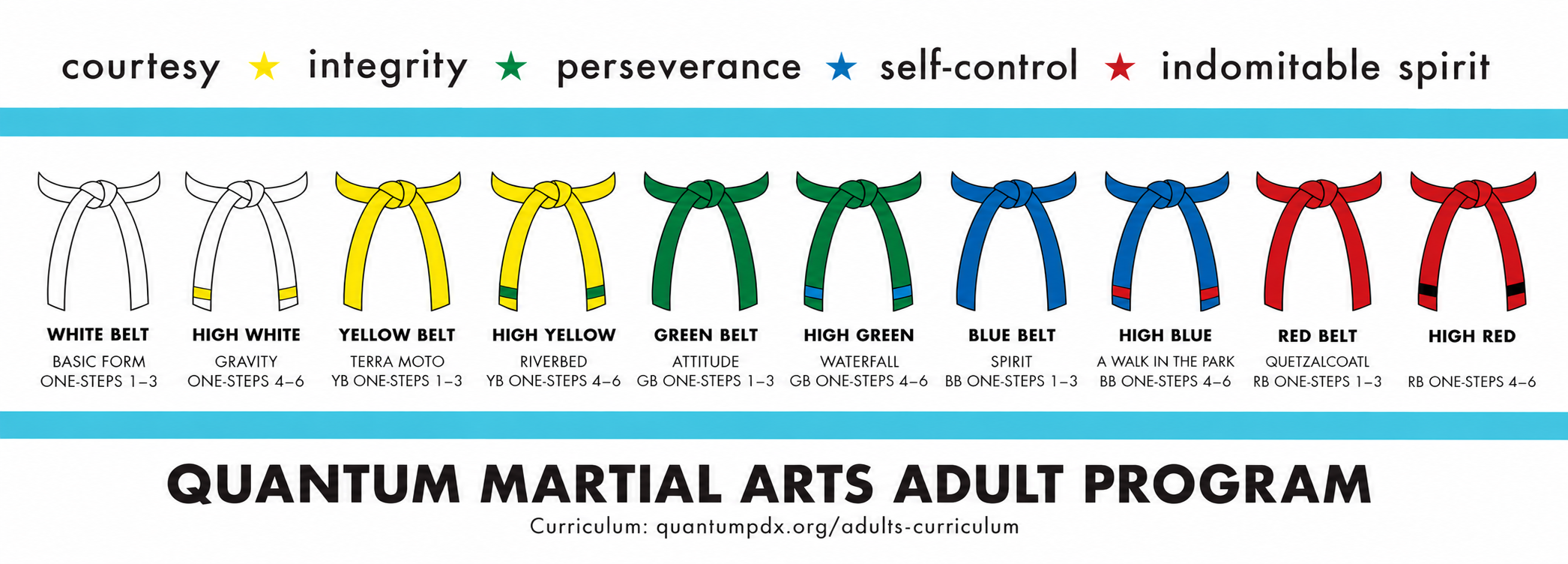
There are two ranks in each of the other color belts. The higher rank is signified by a stripe of the color of the belt that follows. For example a High White Belt would be identified by a pair of yellow stripes on the belt.
Adult Program Belt Rank & Associated Curriculum
What Do I Need For My Next Test?
Remember, your curriculum is cumulative. When you move on to the next rank, you’ll still be required to demonstrate everything that came before it.
-
White belt at Quantum represents a blank slate. The color white symbolizes snow, emptiness, beginner’s mind. At Quantum, all a White Belt is asked to do is to come to class with an open mind and a willingness to learn. By doing so, you will be asked to put aside the narratives you may hold about your own limitations, and allow room for the ever-growing capacities of your body to make themselves known to you.
There are two ranks to each belt, the higher rank denoted by a stripe of the color of the belt that follows. So a ninth gup, or High White Belt, would be identified by the yellow stripe on their white belt.
White Belt Curriculum
High White Belt Curriculum
-
As a brand new yellow belt, making contact during sparring classes has just now become available to you. Sparring is the practical application of the basic techniques you have been learning. Yellow Belt is referred to as “the honeymoon period” – in other words, a time when all the other students will be making room for your growth and learning. The “strike zone” (area where other students are allowed to make contact) is limited to the space between the belt knot and just below the neck. This is limited to light contact only, so you have a good space of time to figure out what is going on without fear of injury.
Sparring is always about the junior ranked person, which will almost always be you! You set the pace, level of contact and the general tone of the round. If at any time you feel as though control or speed becomes an issue, you can always request that the level be dropped a notch to accommodate your training. Be aware of your head! Even though no one is allowed to make head contact, they will focus strikes at your head to make you aware of the danger of dropping your hands or getting “tunnel vision”. Focusing strikes at the head also means that sometimes a strike may slip through – part of the danger of sparring. Generally speaking, there are no serious or chronic injuries in sparring class, but there is the occasional black eye or bloody nose. All students are asked to fight at a level that challenges them without risking serious injury. If you feel that you cannot control a technique, then don’t throw it. There will be a time and place where you have gained enough strength and understanding to apply your new techniques – sometimes it takes longer than others.
There are three different speeds that Yellow Belts are required to understand, the first of which is slow motion. Slow motion sparring is not about hitting targets, but more about showing a flow of breath and movement with balance. Another level of sparring is no contact – this is generally used for White Belts who are testing, for High White Belts, and when control becomes an issue. The third level is the one you will become the most familiar with – light contact at full speed. Control and caution are always the key words when fighting at this level.
There will be many more challenges for you at Yellow Belt. Your curriculum has now expanded into jumping and sliding kicks; your combinations have become more complex and footwork is much more important to understanding technique. Yellow is the color of the seed that is planted in the spring. Learning to sink roots and draw your energy up from the ground is at the center of learning your forms. Movement is key, and it takes a great amount of patience and focus on the task at hand to learn how to propel yourself across the floor. Your forms at yellow belt will teach you the necessary skills of flow and ground and will continue to focus you on the element of Earth.
Yellow Belt CurriculumHigh Yellow Belt Curriculum
-
As a new green belt, it is important that you have an understanding of the intermediate phase of training that you have now entered. Green Belt is not only a time of newfound power and focus, but also a time of returning to basics. Many students end up hitting the “Green Belt wall”- in other words, a major difference in the pace of their training. What creates the major shift in most Green Belts’ training is where you have your “poles reversed”. Green Belts are in a phase of their learning where they must not only learn more, but also refine the movements learned during the Yellow and White Belt phases – a refinement that will never end as long as you train (diligently) in the Martial Arts. After the rapid growth of White and Yellow Belt, Green Belt will seem almost overwhelming. The brand new concepts of sticky hands (Chi Sau), and going back to build on the more subtle aspects of the basics program may seem tedious and boring to some students, however it is extremely important and challenging. Be prepared to spend some quality time at Green Belt – remember – work smart and hard.
The concept of redefining and expanding your roots (basics) and growing forward to explore the new concepts (chi sau; grappling) simultaneously mirrors the image of the grass and trees growing deeper in the places you cannot see, but also growing (albeit more slowly) in the places you can see. This is the essence of the water ranks in the Quantum Style – the growth will not be as noticeable to the student as it used to be. Like the way that water slowly moves rock, slow and steady patience will get you through this phase of your training. Focus on the concepts at hand, not on getting another belt and you will be successful. Chi Sau and grappling training are much more difficult to understand, as you are looking for a feeling, not a particular way to move your body. This takes plenty of time and energy, and frustration often accompanies this phase of your training. Green Belts are encouraged to remember that frustration is present more often when actual learning is happening and not when you are feeling good.
Green Belt also marks new responsibilities in the form of expanded leadership on the floor, running warm – ups and taking a more active approach to assisting on the floor (when requested). Green Belts are also welcome to the Instructor’s training course (permission is required).
Other changes you may notice will be in your sparring. Green Belt sparring begins to include the concept of grappling, as well as other expanded Wing Chun ideas. When fighting with Yellow Belts, you need to see if you can put them at a trapping to a grappling range – they will continue to try to keep you away so they can develop and use their long range kicking skills. When fighting with your peers you will attempt to fight at a trapping hands distance, and possibly look for opportunities for standing submissions, or simple take downs. When fighting with Blue Belts (or above) they will be putting you in standing grappling positions or looking for takedowns. Green Belts should be seeking the outside hands/ trapping range learning to fight by “feel” from the inside. If you find yourself in a position where you are going to the ground, don’t resist – take your ground safely and remember that you are still learning. Every time you go to the ground is an opportunity for you to learn, and it doesn’t mean that you have “lost”. Remember that sparring is not fighting – it is training. As the sparring becomes more detailed, the requirements to purchase sparring gear will become a necessary one. Hand and foot protection are a must, as are mouth guards. Later, head protection may also be needed, as well as forearm and shin pads. A cup supporter is also recommended for male students.
Classroom requirements for maintaining rank actually take effect at the intermediate level as well. Minimum attendance requirements for Green Belts are an average of 2.4 classes a week. High Green must maintain 2.8 times a week, and so on.
The concepts that we learn to employ from Wing Chun are markedly different from the Tae Kwon Do that you have been learning. Where TKD tends to move in rigid straight lines, Wing Chun tends to move in more circular, flowing applications. It becomes even more obvious when you start to notice the difference between the elements of Earth & Water. A successful Green Belt must understand the relationship between these two elements in order to continue to grow towards the next element at Blue Belt, which is Air. Understanding that all trees and grass need Water and Earth to survive – a tricky place to be, as one could end up with mud instead of growth.
In essence, a Green Belt must continue to sink roots to further understand Earth, as well as learning to flow to understand Water, at the same time reaching for the sky for the eventual growth into Blue Belt. Truly this is a different level of challenges than the time of White and Yellow, where one is expected only to work with the concepts of Earth. Green Belt also tends to be the time where many students drop out of the Martial Arts. Be aware and try not to burn out – try to pace your training so that you can make it through. With hard work and patience, Green Belt can be a very rewarding time in the Martial Arts.
Forty classroom hours are required before testing. Also, green students must read the books listed on the Green Belt reading list, and begin to lead warm-ups before classes.
Green Belt Curriculum
High Green Belt Curriculum
-
The color blue introduces the element of air into the Quantum style. The Blue Belt student learns about the power of air, and how to pull what you need from the air around you. Learning to fly is the key to finding out about this color, and the Blue Belt soars to new heights in their training.
Blue Belt Curriculum
High Blue Belt Curriculum
-
Fire is the focus element at Red Belt, as students begin to learn and define speed, potential energy, the electricity in motion, and redirection. At the level of Red Belt, students truly step in to the role of teacher and begin to understand what it is to teach martial arts.
Red Belt Curriculum
Form (Quetzalcoatl)
High Red Belt Curriculum
-
Check with your Instructor.